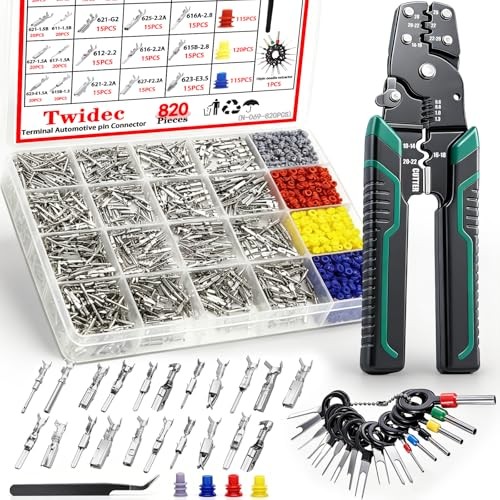

Photos from current listings. Actual item, color, and included accessories may vary.
Electrical Buying Guide
Electrical buyers in this segment are typically purchasing connector kits, crimp tools, and wiring components to build or repair automotive circuits. The primary trade-off is between universal, low-cost kits with thin terminals and plated contacts versus professional-grade terminals with sealed connectors and calibrated crimp tools. The decision rule: buy kits that specify terminal plating (tin vs. brass), wire gauge range (AWG), and include a ratcheting crimper; skip kits that list only piece counts without material or gauge standards.


At a glance
- Category
- Electrical, Sensors & Switches
- Data updated
- Nov 15, 2026
Current offers
Highlights
- Terminal plating determines corrosion resistance: tin-plated copper terminals resist oxidation in humid engine bays, while bare brass terminals corrode faster and increase resistance.
- Crimp tool type separates reliable kits from throwaway sets: ratcheting crimpers with interchangeable dies deliver consistent crimp height, while plier-style crimpers deform terminals and cause intermittent connections.
- Wire gauge coverage must match your circuit load: 22-16 AWG suits sensor and signal wiring, 16-14 AWG handles lighting and accessories, 12-10 AWG is required for main power feeds and high-amp circuits.
- Connector sealing class matters for automotive use: unsealed kits are fine for cabin wiring, but engine-bay and exterior runs need sealed connectors with silicone grommets or heat-shrink boots.
Best use cases
- Best fit for DIY automotive wiring and 12V accessory installs: choose a kit with 22-10 AWG coverage, tin-plated terminals, and a ratcheting crimper to handle sensors, lights, and relay circuits in one purchase.
- Best fit for marine or off-road exposure: pick sealed connectors rated IP67 or higher with adhesive-lined heat shrink, and skip open-barrel unsealed terminals that wick moisture.
- Wrong fit for high-current main feeds (starter, winch, alternator): connector kits max out at 10 AWG; use dedicated 8-4 AWG lug terminals and hydraulic crimpers instead.
- Wrong fit for production-line or safety-critical harnesses: hobby kits lack TPA (terminal position assurance) locks and OEM-style sealed housings; specify OEM-connector pigtails for those repairs.
Buying tips
- Match wire gauge to load before counting pieces: 22-16 AWG for signals, 16-14 AWG for 10-15A accessory circuits, 12-10 AWG for 20-30A runs; a kit that stops at 16 AWG cannot handle main power.
- Choose tin-plated copper terminals over bare brass for any connection exposed to humidity or temperature swings; plating thickness and crimp barrel length are the durability drivers, not piece count.
- Insist on a ratcheting crimper with dies matched to terminal type (insulated, non-insulated, open-barrel); plier-style crimpers and combo stripper-crimpers produce weak, inconsistent crimps.
- For underhood use, select connectors with silicone seals and a locking latch; unsealed spade and bullet connectors vibrate loose and corrode at the terminal interface.
Specs
| Terminal Plating | Tin-plated copper vs bare brass |
|---|---|
| Wire Gauge Range | 22-10 AWG (signal to power) |
| Crimp Tool Type | Ratcheting vs plier-style |
| Connector Sealing | Unsealed vs IP67 sealed |
Related searches
What to check before buying
- Measure your circuit's maximum current and wire gauge at the connection point: confirm the kit's terminal barrels and crimp dies cover that AWG range (e.g., 12-10 AWG for 20A+ circuits).
- Identify the environment: cabin/dry locations accept unsealed terminals, but engine bay, chassis, and exterior runs require sealed connectors and adhesive-lined heat shrink.
- Verify your crimp tool plan: confirm the kit includes a ratcheting crimper with the correct die for insulated or non-insulated terminals you will use, or budget for a separate tool.
- Check connector mating standards: for OEM repairs, match the housing series (e.g., Metri-Pack, Weather Pack, Deutsch DT) rather than generic spade terminals to ensure plug-and-play fit.
FAQ
Data sources: eBay / Amazon listings and product attribute feeds Data updated Nov 15, 2026.
Some links on this page are affiliate links. If you buy after clicking one, we may earn a commission at no extra cost to you. This does not change which products appear here or their order. Affiliate disclosure.