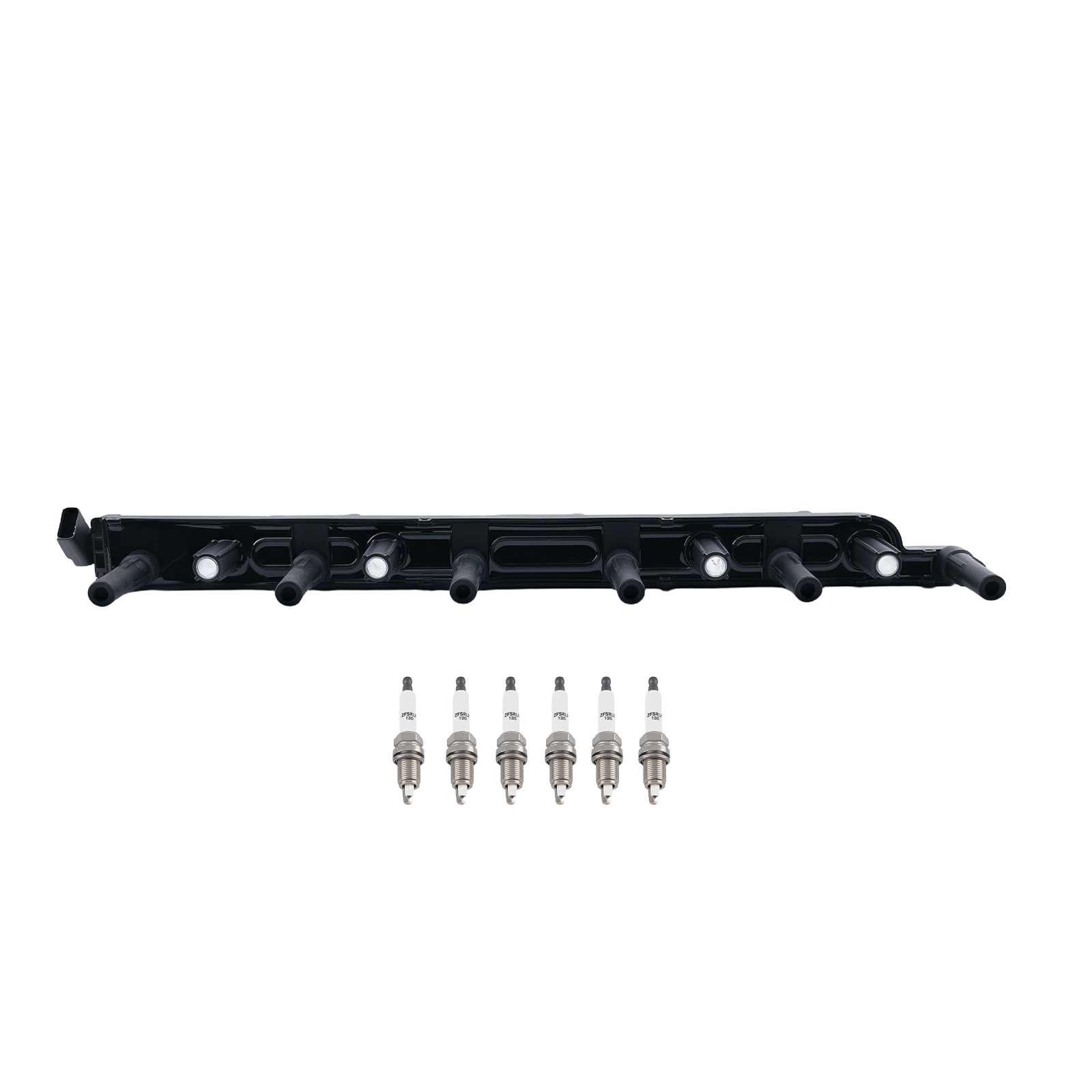

Photos from current listings. Actual item, color, and included accessories may vary.
Jeep Ignition Coil Buying Guide
A Jeep ignition coil is the step-up transformer that converts 12V battery voltage into the 20–40 kV needed to fire the spark plugs, and the primary trade-off is between oil-filled canister coils (durable, serviceable, stock-style) and modern epoxy-potted or coil-on-plug (COP) designs that resist vibration but are sealed and non-repairable. Buy the coil that matches your engine management generation and mounting footprint: older 4.0L inline-six and 2.5L four-cylinder Jeeps use a remote canister coil feeding a distributor, while 2000+ 4.0L and 3.6L/3.8L V6 engines use distributorless coil packs or individual COP units. The decision rule: confirm engine code, ignition architecture, and primary resistance before buying—different generations are not interchangeable even when they physically bolt up.


At a glance
- Category
- Engine, Exhaust & Fuel System Parts
- Data updated
- Nov 15, 2026
Current offers
Highlights
- Older 4.0L (1987–1999) and 2.5L Jeeps use a single oil-filled canister coil (typically 0.8–1.5Ω primary) mounted on the inner fender, firing through a distributor cap and rotor.
- 2000–2006 4.0L Jeep engines switched to a distributorless waste-spark coil rail with three dual-output towers; each tower fires two cylinders simultaneously, so a single failed tower misfires two cylinders.
- JK Wrangler 3.8L (2007–2011) uses a coil pack with six dedicated outputs; the 3.6L Pentastar (2012+) uses individual coil-on-plug units, one per cylinder, mounted directly over the spark plug.
- Coil output is rated in secondary voltage (typically 25–40 kV) and energy (mJ); epoxy-potted COP coils handle vibration and heat better than oil-filled canisters but cannot be opened or re-oiled.
Best use cases
- Best fit: 1990s Cherokee XJ or Wrangler TJ 4.0L with a distributor—buy a single oil-filled canister coil plus cap, rotor, and plug wires; skip COP kits that require harness rewiring.
- Best fit: 2000–2006 4.0L with the three-tower coil rail—replace the entire rail, not individual towers, and pair with fresh spark plugs gapped to 0.035 in (0.89 mm).
- Best fit: 2012+ Pentastar 3.6L—buy individual OEM-equivalent COP coils for the specific misfiring cylinder; skip universal coil packs that don't match the plug-well depth.
- Wrong fit: buying a canister coil for a distributorless engine or a COP set for a distributor engine—the harness connectors and ECU dwell signals are incompatible even if the bolt pattern looks similar.
Buying tips
- Match coil primary resistance to the OEM spec: canister coils typically measure 0.8–1.5Ω; a reading outside that band means the coil is failing or the wrong part.
- For 2000–2006 4.0L coil rails, confirm three towers and the correct connector keyway—early and late rails look alike but use different harness plugs.
- For 3.6L Pentastar COP coils, verify the boot length and spring contact match the plug well; short boots cause arcing and repeat misfires.
- Replace coils in matched sets when one fails on waste-spark systems, because the paired cylinder shares the same coil and degraded insulation accelerates failure.
Specs
| Ignition Type | Distributor canister vs coil rail vs COP |
|---|---|
| Primary Resistance | 0.8–1.5Ω canister; OEM-spec COP |
| Tower Count | 1 (canister) / 3 (rail) / 6 (COP) |
| Engine Fitment | 4.0L, 2.5L, 3.8L, 3.6L Pentastar |
Related searches
What to check before buying
- Identify engine code and year (e.g., 4.0L XJ vs TJ vs 2000+ coil rail) before ordering—ignition architecture changed mid-generation and parts do not interchange.
- Measure the existing coil's primary resistance with a multimeter and compare to the OEM service spec to confirm the correct replacement tier.
- Check the harness connector type and pin count (2-pin canister vs multi-pin rail vs COP) and confirm the new coil matches without adapter pigtails.
- Inspect plug well depth and boot length on COP engines; verify the coil seats fully and the retaining bolt or clip engages before torqueing.
FAQ
Data sources: eBay / Amazon listings and product attribute feeds Data updated Nov 15, 2026.
Some links on this page are affiliate links. If you buy after clicking one, we may earn a commission at no extra cost to you. This does not change which products appear here or their order. Affiliate disclosure.