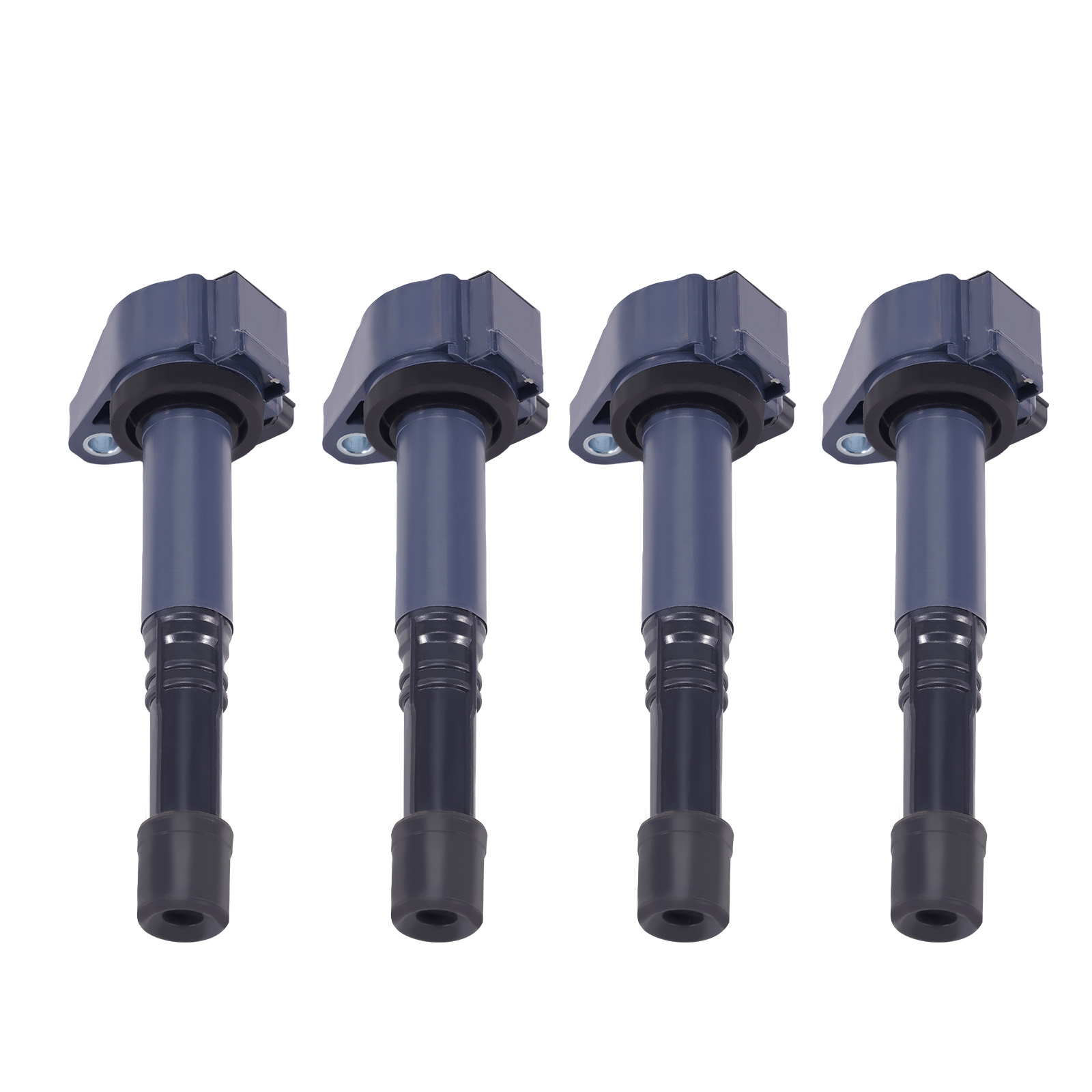

Photos from current listings. Actual item, color, and included accessories may vary.
Honda Ignition Coil Buying Guide
Honda ignition coils are the step-up transformers that fire the spark plugs; the key trade-off is OEM-style epoxy-potted coils with correct primary resistance versus cheaper oil-filled or unsealed coils that fail under heat and vibration. The decision rule: match the coil's primary resistance, connector keying, and mounting footprint to your exact engine code, and buy a full set of four for 2.4L I4 applications rather than mixing old and new coils.


At a glance
- Category
- Engine, Exhaust & Fuel System Parts
- Data updated
- Nov 15, 2026
Current offers
Highlights
- 2.4L I4 Honda engines (CR-V 2015-2019, Accord 2013-2017, Acura ILX/TLX 2015-2020) use four individual coil-on-plug units, so a complete set is the correct service unit.
- OEM-style coils are epoxy-potted with sealed secondary towers; oil-filled aftermarket coils are cheaper but leak and arc under sustained high-temperature cycling.
- Primary resistance typically falls in the 0.5-1.5 ohm range and secondary resistance in the 5-15 kOhm range; coils outside these windows stress the ignition module.
- Connector keying and coil boot length differ by engine code (K24 vs R20 vs J35), so a coil that physically bolts down can still misalign the spark plug terminal.
Best use cases
- Best fit: a 2.4L I4 Honda/Acura with a single misfire code (P0301-P0304) — replace all four coils as a set with epoxy-potted units matching the original connector key.
- Best fit: high-mileage engines over 100,000 miles showing heat-cracked coil boots — choose coils with silicone boots and sealed secondary towers, not bare plastic.
- Wrong fit: turbocharged or high-compression builds — stock-resistance coils are not tuned for increased cylinder pressure; specify a coil rated for the boosted gap.
- Skip: buying one coil to replace a failed unit on a 100k-mile engine — mismatched primary resistance across old and new coils causes uneven spark energy and repeat misfires.
Buying tips
- Count cylinders first: 2.4L I4 Honda engines take four coils; V6 J35 engines take six — order the set size matching your engine, not the listing photo.
- Match primary resistance with a multimeter before install: 0.5-1.5 ohm is the normal window; a reading near zero indicates a shorted primary.
- Choose epoxy-potted coils over oil-filled: potting resists vibration and thermal cycling, which is the leading cause of coil-on-plug failure.
- Verify connector keying and boot length against your engine code — K24, R20, and J35 coils share mounting bolts but differ in plug depth and terminal orientation.
Specs
| Coil Type | Coil-on-plug (COP) individual |
|---|---|
| Primary Resistance | 0.5-1.5 ohm |
| Secondary Resistance | 5-15 kOhm |
| Construction | Epoxy-potted vs oil-filled |
Related searches
What to check before buying
- Confirm engine code and displacement (e.g., K24W 2.4L I4) from the vehicle's underhood emissions label before ordering a coil set.
- Measure existing coil primary and secondary resistance to establish a baseline and confirm the fault is the coil, not the plug or injector.
- Inspect spark plug tube seals and valve cover gasket — oil pooling in the tube destroys new coils regardless of coil quality.
- Check plug gap and heat range: a worn or wrong-gap plug overloads a new coil and can cause premature secondary winding failure.
FAQ
Data sources: eBay / Amazon listings and product attribute feeds Data updated Nov 15, 2026.
Some links on this page are affiliate links. If you buy after clicking one, we may earn a commission at no extra cost to you. This does not change which products appear here or their order. Affiliate disclosure.