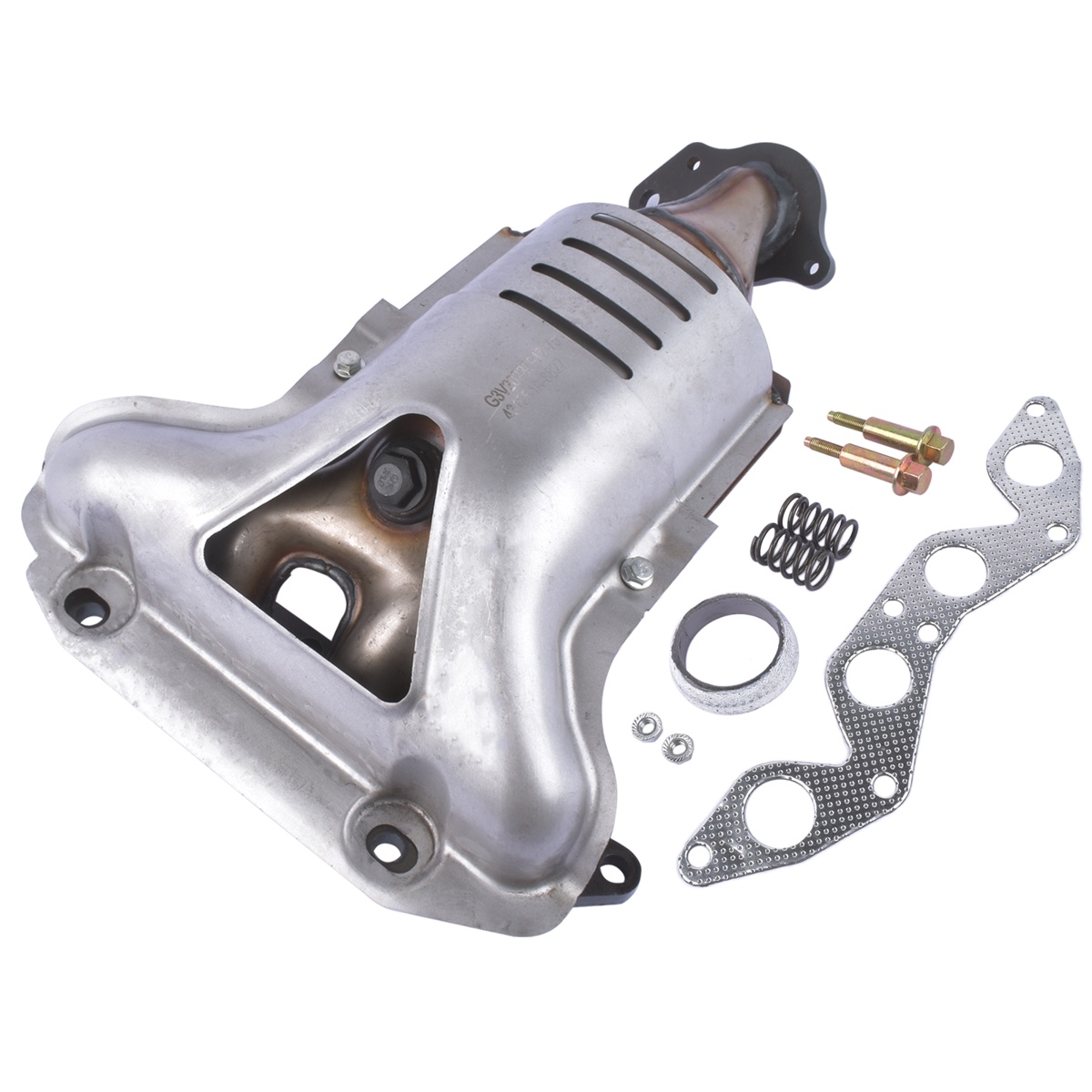

Photos from current listings. Actual item, color, and included accessories may vary.
Honda Catalytic Converter Buying Guide
A Honda catalytic converter is an emissions-control device that converts harmful exhaust gases into less harmful ones using a precious-metal catalyst; the primary trade-off is between costly OEM direct-fit units with guaranteed CARB/EPA compliance and lower-cost universal or 49-state units that may require welding and can fail inspection. The clear decision rule: if your Honda is registered in a CARB state (CA, NY, ME, etc.) or you want bolt-on fitment, buy an EPA/CARB-certified direct-fit converter matched to your engine code and model year; only choose a universal weld-in unit if you have fabrication skills and live in a non-CARB state.


At a glance
- Category
- Engine, Exhaust & Fuel System Parts
- Data updated
- Nov 15, 2026
Current offers
Highlights
- OEM vs aftermarket: OEM Honda converters use high precious-metal loadings (Pt/Pd/Rh) and exact flange geometry; aftermarket direct-fit units match bolt patterns but often carry lower metal loading and shorter warranty.
- CARB vs EPA compliance: California and Section 177 states require CARB-executive-order converters; 49-state EPA converters are legal only in non-CARB states and will fail visual/smog checks where CARB is required.
- Direct-fit vs universal: Direct-fit converters bolt to factory flanges and include correct O2 sensor bungs and heat shields; universal units are weld-in and require cutting, welding, and sensor bung fabrication.
- Construction grade: Quality converters use stainless-steel outer shells and ceramic or metallic honeycomb substrates; thin aluminized shells rust through in salt-belt climates, while 409 stainless lasts significantly longer.
Best use cases
- Best fit: daily-driven 2001-2005 Honda Civic DX/LX/CX/HX 1.7L with a failed converter in a non-CARB state — choose a direct-fit EPA converter with correct 18160-PLM-A50/A00 flange and O2 bung locations.
- Best fit: Honda registered in California or a CARB state — buy only a CARB-executive-order direct-fit converter; universal or 49-state units are illegal and will fail smog inspection.
- Wrong fit: rust-belt Honda with a rusted-out factory exhaust — skip a cheap aluminized universal unit and choose a 409 stainless direct-fit converter or complete cat-back assembly to avoid repeat failure.
- Wrong fit: performance-modified Honda with aftermarket header — a stock direct-fit converter will not align; choose a universal high-flow metallic-substrate converter and weld to theheader collector.
Buying tips
- Match the converter to your engine code and model year: 2001-2005 Civic 1.7L uses 18160-PLM-A50 or A00; D17A2 VTEC and D17A1 non-VTEC share the same flange pattern but verify O2 sensor count (upstream and downstream).
- Check your state's emissions standard before buying: CARB requires an executive order (EO) number stamped on the converter; EPA 49-state units lack EO numbers and are illegal in CA, NY, ME, MA, VT, CO, WA, OR, and other Section 177 states.
- Measure your existing exhaust flange bolt spacing and pipe diameter: direct-fit converters use factory 2-bolt or 3-bolt flanges; a mismatch means cutting and welding, which negates the direct-fit premium.
- Choose 409 stainless steel over aluminized steel for any vehicle driven in road-salt climates; 409 resists rust 3-5x longer and typically carries a longer warranty (5 years/50k miles vs 2 years/25k miles).
Specs
| Emissions Standard | CARB EO vs EPA 49-state |
|---|---|
| Fitment Type | Direct-fit bolt-on vs universal weld-in |
| Shell Material | 409 stainless vs aluminized steel |
| Substrate Type | Ceramic honeycomb vs metallic |
Related searches
What to check before buying
- Verify your Honda's model year, engine displacement (1.7L), and trim (DX/LX/CX/HX) against the converter's application list — Honda changed flange patterns across generations.
- Confirm your state's emissions tier (CARB vs EPA 49-state) by checking the DMV or emissions inspection website before ordering; CARB converters carry an EO number on the unit.
- Inspect your existing exhaust system for rust at flanges and hangers; a seized or rusted flange bolt may require a new gasket and hardware kit, and rusted pipes may need replacement.
- Check O2 sensor quantity and location: 2001-2005 Civic 1.7L uses two sensors (upstream and downstream); the converter must have both bungs in the correct positions or the ECU will throw P0420.
FAQ
Data sources: eBay / Amazon listings and product attribute feeds Data updated Nov 15, 2026.
Some links on this page are affiliate links. If you buy after clicking one, we may earn a commission at no extra cost to you. This does not change which products appear here or their order. Affiliate disclosure.