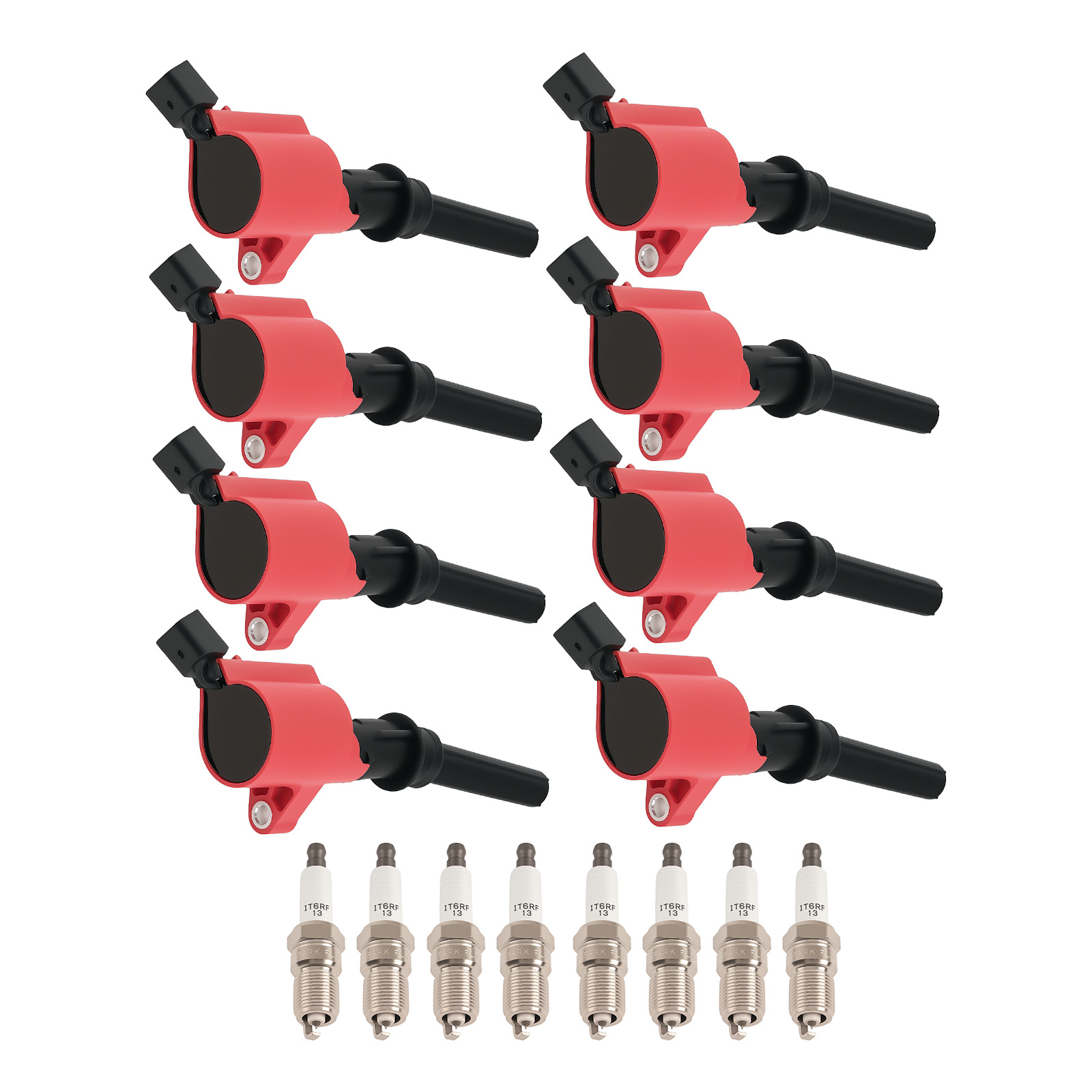

Photos from current listings. Actual item, color, and included accessories may vary.
Ford Ignition Coil Buying Guide
A Ford ignition coil is the transformer that steps battery voltage up to the 20–40 kV needed to arc across the plug gap, and the segment splits into two hard rules: coil-on-plug (COP) units for modern modular engines and coil packs for older distributor or wasted-spark systems. Buy by exact engine family, plug-boot length, and primary resistance—not by vehicle name alone—because a coil that physically fits but mismatches resistance will misfire, overheat, or kill the ignition module. Durable options match OEM primary resistance within about 0.1–0.3 ohms per coil family, use epoxy-potted windings and silicone boots, and carry a 12-month-or-longer warranty.


At a glance
- Category
- Engine, Exhaust & Fuel System Parts
- Data updated
- Nov 15, 2026
Current offers
Highlights
- Ford modular 4.6L/5.4L/6.8L V8s use individual COP coils with long plug boots; earlier pushrod and distributor engines use a single central coil or a coil pack.
- Primary resistance typically runs about 0.3–1.0 ohms for COP coils; secondary resistance is roughly 5–15 kΩ, and drifting outside these bands causes weak or no spark.
- Coil boot material and epoxy potting decide heat and moisture survival—silicone boots resist exhaust-side bake better than cheap EPDM, and fully potted windings resist vibration.
- Genuine Motorcraft (DG-series) coils are the OEM baseline; aftermarket equivalents must match the same resistance band and connector keying or they will misfire or set P0351–P0358 codes.
Best use cases
- Best fit: a 2001–2008 F-150 or Crown Victoria 4.6L showing a single-cylinder misfire—replace the one failed COP coil and its plug, keeping the set matched to the same resistance band.
- Best fit: a high-mileage 4.6L/5.4L with multiple misfires—replace all eight coils and plugs as a set so aging coils don't fail one by one and trigger repeat repairs.
- Wrong fit: buying a generic 'fits Ford' coil without confirming engine displacement, year range, and boot length—same-name coils differ between 2V, 3V, and 4V modular heads.
- Wrong fit: putting a coil-pack-era coil on a COP engine or vice versa—the driver circuit and connector keying differ and the engine will not run cleanly.
Buying tips
- Match by engine displacement and valve count (4.6L 2V vs 3V vs 4V) plus model year, because boot length and connector keying change across modular generations.
- Verify primary resistance with a multimeter before install—COP coils generally read about 0.3–1.0 ohms; a reading far outside that band signals a mismatched or failing coil.
- Replace plugs with the coils; worn plugs raise firing voltage and shorten coil life, and gapping must match the engine's spec (often 0.052–0.056 in on 4.6L modulars).
- Prefer epoxy-potted windings and silicone boots over open-frame or unsealed designs on exhaust-side positions, where heat and oil vapor attack the boot.
Specs
| Coil Type | COP vs coil pack vs central |
|---|---|
| Primary Resistance | ~0.3–1.0 ohm (COP) |
| Secondary Resistance | ~5–15 kΩ |
| Boot Material | Silicone vs EPDM rubber |
Related searches
What to check before buying
- Confirm engine family, displacement, valve count, and model year—not just 'F-150'—before ordering any COP coil.
- Measure existing coil primary/secondary resistance and inspect boot length so the replacement matches the original connector and reach.
- Check spark plug well and valve-cover condition: oil pooling in the well degrades boots and is often mistaken for a failed coil.
- Verify the coil connector keying and polarity for your harness; if converting coil types, confirm the ignition driver and wiring match.
FAQ
Data sources: eBay / Amazon listings and product attribute feeds Data updated Nov 15, 2026.
Some links on this page are affiliate links. If you buy after clicking one, we may earn a commission at no extra cost to you. This does not change which products appear here or their order. Affiliate disclosure.