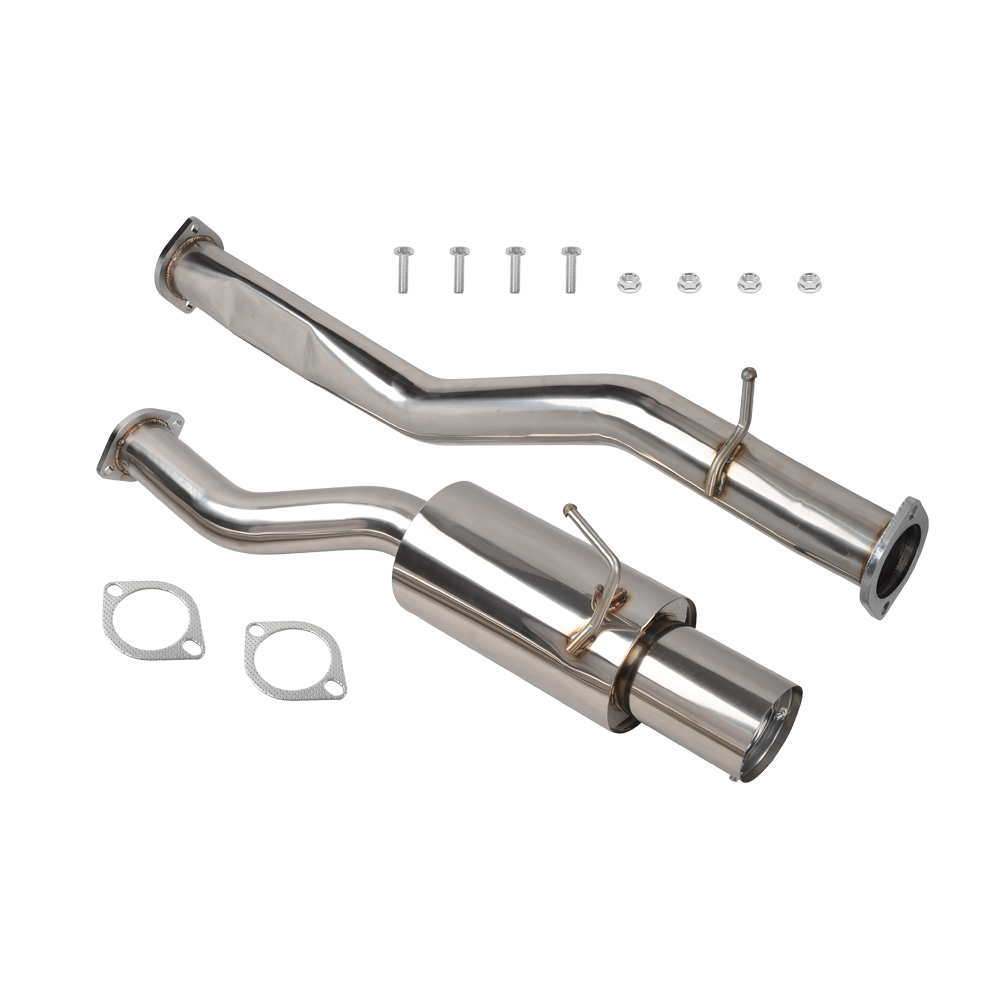

Photos from current listings. Actual item, color, and included accessories may vary.
Cat Back Exhaust Buying Guide
A cat-back exhaust replaces everything from the catalytic converter rearward—mid-pipe, resonator/muffler, and tailpipe—so it controls sound, flow, and tip fitment without touching emissions legality. The core trade-off is pipe diameter and steel grade: 2.25–2.5 in mandrel-bent 304 stainless preserves scavenging and lasts a decade, while 2.75–3 in crush-bent 409/aluminized steel favors peak flow and budget but drones and rusts sooner. The decision rule: match diameter to your power level, demand mandrel bends and 304 at the flanges, and skip any kit that reuses the factory downpipe without a stated adapter.


At a glance
- Category
- Engine, Exhaust & Fuel System Parts
- Data updated
- Nov 15, 2026
Current offers
Highlights
- Pipe sizing sets the tone: 2.25–2.5 in suits stock to lightly tuned NA engines, 2.75–3 in is for forced induction or cams; oversized pipe on a stock engine kills low-end torque and amplifies drone.
- Bend method and steel grade are the durability split: mandrel-bent 304 stainless keeps true internal diameter and resists salt corrosion; crush-bent aluminized or 409 steel necks down at bends and surface-rusts within a few winters.
- Construction details that predict fit and sound: TIG-welded seams, 3/8–1/2 in thick flanges, and a Helmholtz or resonated mid-pipe control rasp; straight-through glasspacks are loudest and least livable at highway speed.
- Fitment is chassis-specific, not universal: hanger locations, tip exit (single vs dual, rolled vs slash-cut), and flange bolt pattern must match the exact generation—350Z/G35 coupe and sedan pipes differ at the mid-section.
Best use cases
- Daily-driven stock or bolt-on NA car: pick a 2.25–2.5 in mandrel-bent 304 kit with a resonated mid-pipe and chambered muffler—skip 3 in straight-through systems that drone at 2,000–3,000 rpm.
- Forced-induction or cammed build: choose 2.75–3 in mandrel-bent 304 with a straight-through muffler and v-band clamps; skip crush-bent budget kits that choke flow and leak at slip joints.
- Weekend/track car where sound is secondary: a 3 in single-exit 304 system saves weight and maximizes top-end; skip dual-exit show kits if clearance and weight matter more than symmetry.
- Winter-salt climate or long ownership: buy 304 stainless with stainless flanges and hardware; skip aluminized steel, which rusts from the inside out at weld seams.
Buying tips
- Measure your factory rear pipe: stock NA four-cylinders rarely benefit beyond 2.25–2.5 in; turbo cars target 3 in per 300–400 hp as a rough flow rule.
- Insist on mandrel bends and 304 grade at least for the muffler and flanges; crush-bent 409 is acceptable only for budget builds in dry climates.
- Confirm the kit includes the mid-pipe and adapter to the factory cat or downpipe; cat-back systems that bolt to a stock downpipe need the matching flange and donut gasket.
- Check hanger rod positions and tip exit against your bumper cutout—dual-exit systems on single-exit bumpers require trimming or a valance.
Specs
| Pipe Diameter | 2.25–3.0 in (NA vs forced induction) |
|---|---|
| Steel Grade | 304 stainless vs 409/aluminized |
| Bend Type | Mandrel-bent vs crush-bent |
| Muffler Design | Chambered/resonated vs straight-through |
Related searches
What to check before buying
- Verify your exact chassis code, body style (coupe vs sedan), and engine—mid-pipe length and hanger points differ within the same model line.
- Measure bumper cutout width and depth plus ground clearance for the tip; a 4–4.5 in tip can melt or touch plastic without a proper exit angle.
- Confirm flange bolt count/spacing and whether the kit needs a donut or flat gasket, plus new stainless nuts and bolts.
- For salt-belt use, verify 304 stainless construction and stainless hangers; aluminized systems need annual inspection at welds.
FAQ
Data sources: eBay / Amazon listings and product attribute feeds Data updated Nov 15, 2026.
Some links on this page are affiliate links. If you buy after clicking one, we may earn a commission at no extra cost to you. This does not change which products appear here or their order. Affiliate disclosure.