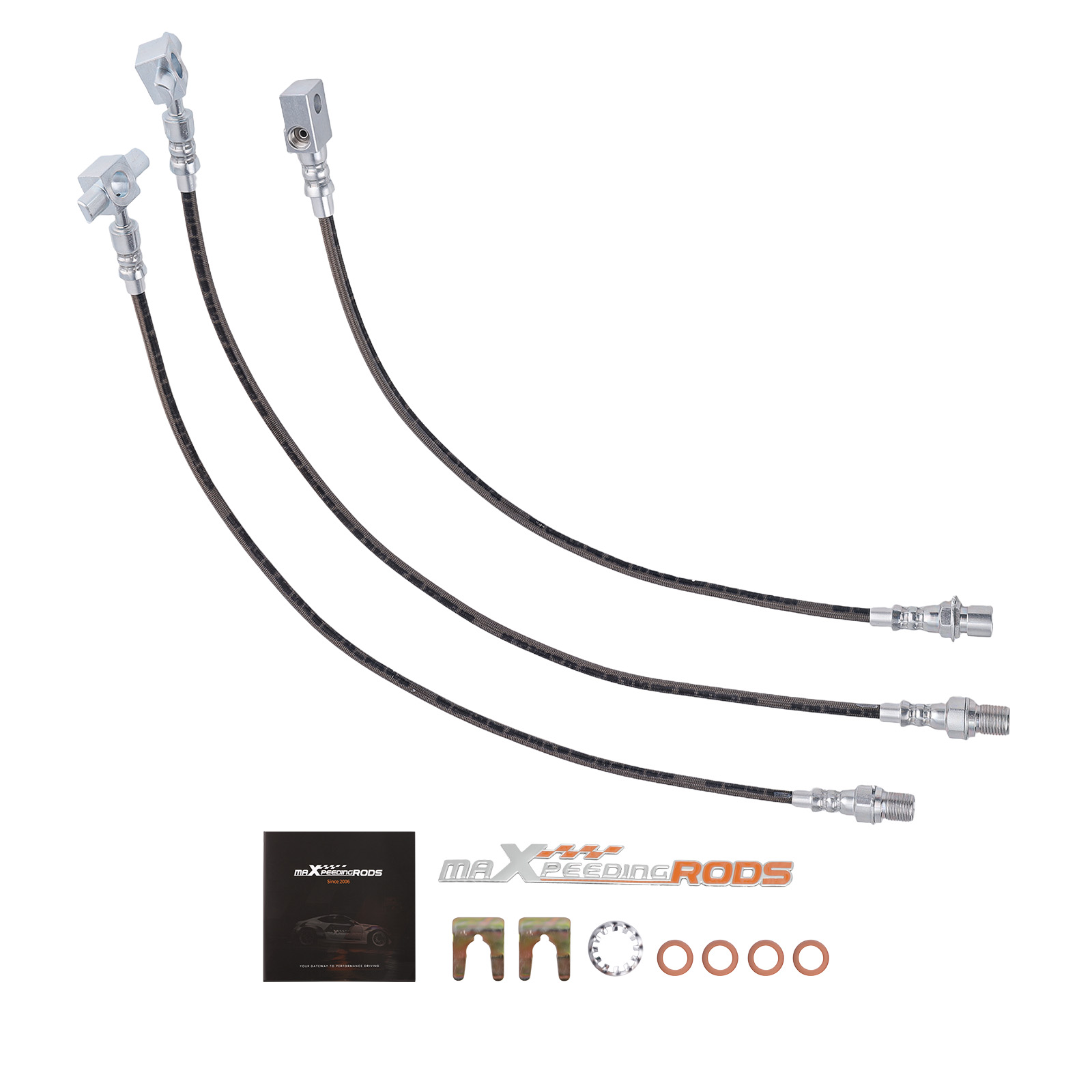

Photos from current listings. Actual item, color, and included accessories may vary.
Stainless Steel Brake Line Kit Buying Guide
A stainless steel brake line kit replaces OEM rubber hoses with braided stainless-over-PTFE lines to resist expansion, abrasion, and corrosion under high pressure. The core trade-off is between DOT-approved crimped assemblies and generic barb-and-clamp kits that can fail inspection or leak. Buy only kits with DOT compliance, vehicle-specific fittings, and a documented burst rating above 3,000 psi.


At a glance
- Category
- Suspension, Steering & Brake Parts
- Data updated
- Nov 15, 2026
Current offers
Highlights
- DOT-approved kits use PTFE inner hose with stainless braid and crimped zinc-plated steel fittings; non-DOT kits often use clamped fittings that are not street-legal.
- Braided stainless lines reduce volumetric expansion versus rubber, improving pedal firmness and brake modulation under hard use.
- Lifted-truck kits (e.g., Chevy/GMC C10/K10 1971-1987) add 2-4 inches of length; stock-length lines on lifted suspensions can stretch and fail at full droop.
- Stainless braid resists abrasion and UV cracking, but the PTFE core still has a finite flex life; routing away from sharp edges and exhaust heat is mandatory.
Best use cases
- Best fit: Lifted 1971-1987 Chevy/GMC C10/K10 trucks needing longer front and rear lines; pick a kit explicitly rated for the lift height and axle configuration.
- Best fit: Performance or track cars seeking firmer pedal feel; choose a DOT-approved four-wheel kit with banjo or inverted-flare fittings matching the caliper and hard-line ends.
- Wrong fit: Daily drivers with stock suspension and no corrosion or expansion issues; fresh OEM rubber lines are cheaper and sufficient.
- Skip: Universal cut-to-length braided hose with worm-gear clamps; these are not DOT-compliant for street use and prone to leaks at the clamp.
Buying tips
- Match fitting types exactly: inverted flare (3/8-24, 7/16-20), banjo with specific banjo bolt size, or metric bubble flare; kits list vehicle-specific ends.
- Confirm DOT compliance (FMVSS 106) for any street-driven vehicle; non-DOT lines may fail safety inspection and void insurance coverage.
- For lifted trucks, add 1 inch of line length per 1 inch of lift beyond stock, and verify full-droop and full-steer clearance before tightening.
- Check burst and working pressure ratings: street kits should rate at least 3,000 psi burst; race kits often 5,000 psi or higher.
Specs
| Hose Construction | PTFE core + stainless braid |
|---|---|
| DOT Compliance | FMVSS 106 approved or non-DOT |
| Burst Pressure | 3,000-5,000+ psi |
| Lift Compatibility | Stock to 2-4 in lift lengths |
Related searches
What to check before buying
- Measure your current hard-line fitting sizes and caliper connection type before ordering; kits are vehicle-specific and mis-sized fittings will leak.
- For lifted vehicles, measure suspension droop and steering lock-to-lock to confirm the kit's added length clears without binding.
- Verify the kit includes new copper crush washers and banjo bolts where applicable; reusing old washers causes leaks.
- Inspect hard lines and calipers for corrosion before install; stainless flex lines won't fix a seized caliper or rusted hard line.
FAQ
Data sources: eBay / Amazon listings and product attribute feeds Data updated Nov 15, 2026.
Some links on this page are affiliate links. If you buy after clicking one, we may earn a commission at no extra cost to you. This does not change which products appear here or their order. Affiliate disclosure.