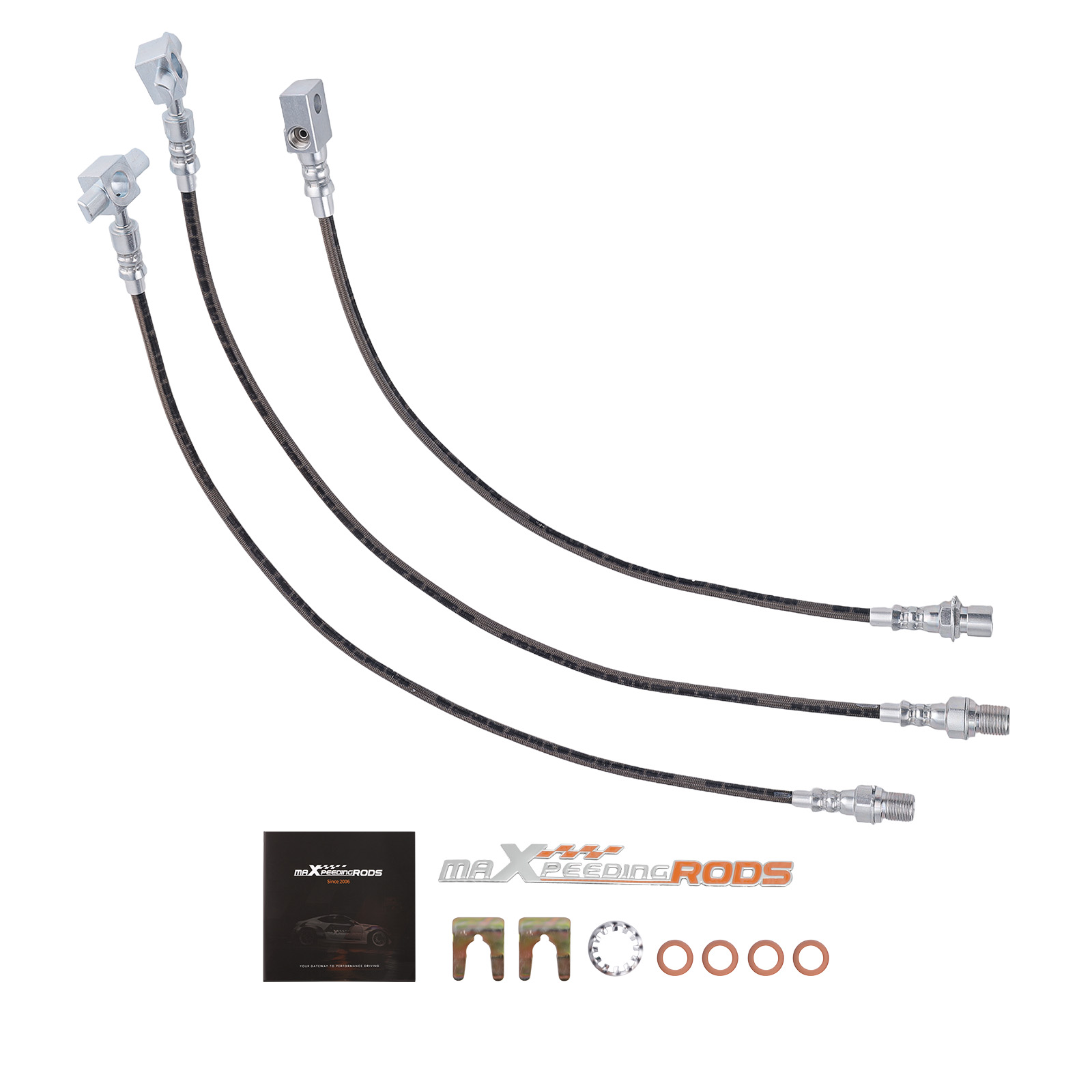

Photos from current listings. Actual item, color, and included accessories may vary.
Stainless Brake Line Buying Guide
Stainless brake lines are replacement brake hoses with a braided stainless-steel outer sheath over a PTFE (Teflon) inner core, designed to resist expansion under pressure and abrasion. The primary trade-off is between DOT-approved crimped assemblies (legal, tested, durable) and DIY/AN-fitted lines (flexible but often not street-legal). The clear decision rule: buy only pre-assembled, DOT-certified lines with stainless fittings and a protective coil or clear coat for street use; reserve field-serviceable AN fittings for off-road or race trailers.


At a glance
- Category
- Suspension, Steering & Brake Parts
- Data updated
- Nov 15, 2026
Current offers
Highlights
- DOT certification (FMVSS 106) requires burst pressure ≥ 4,000 psi and whip testing; non-DOT AN lines may fail legally and in crash safety inspections.
- PTFE inner core resists brake fluid degradation and expansion far better than rubber, but needs a stainless braid to prevent kinking and abrasion.
- Stainless fittings (303/316) resist corrosion; zinc-plated steel fittings rust quickly in road-salt climates, so specify stainless or nickel-copper alloy.
- Lift-specific kits (e.g., for 71-87 Chevy/GMC C10/K10) add 2-4 inches of length; stock-length lines on lifted trucks can stretch and fail at full droop.
Best use cases
- Best fit: daily-driven or restored classic trucks (C10/K10) needing firmer pedal and abrasion resistance — choose a DOT-certified stock or lifted-length kit with stainless fittings.
- Best fit: off-road or trail rigs with long-travel suspension — pick extended-length (2-4 in over stock) braided lines with protective coil and AN or banjo ends as required.
- Wrong fit: race-only or custom builds planning to cut and flare lines at home — skip pre-assembled DOT kits and use field-serviceable AN fittings with a proper flaring tool; never mix DOT and AN on one circuit without matching threads.
Buying tips
- Match length to lift: measure hose eye-to-eye at full suspension droop, then add 1 inch slack; a 2-4 inch lift typically needs 2-4 inch longer lines than stock.
- Verify thread and fitting type: banjo (10mm or 12mm) vs inverted flare (3/8-24, 7/16-20) must match your caliper and hard-line ends exactly — bring a sample or measure thread pitch.
- Prioritize DOT marking and stainless fittings: a DOT print on the crimp collar plus 303/316 stainless steel ends signals legal, corrosion-resistant construction.
- Avoid bare braid on street cars: unprotected stainless braid abrades nearby lines and traps grit; choose a clear-coated or coiled sleeve for daily use.
Specs
| Certification | DOT FMVSS 106 vs non-DOT |
|---|---|
| Inner Core | PTFE vs rubber |
| Fitting Material | Stainless 303/316 vs zinc steel |
| Length Option | Stock vs +2-4 in lifted |
Related searches
What to check before buying
- Measure your current hose length at ride height and at full droop; compare to kit length to avoid stretch or rubbing.
- Confirm fitting type and thread at both ends (banjo bolt size or inverted flare thread) against your caliper and hard line.
- Inspect routing clearance: new braided lines must not contact tires, control arms, or exhaust; add clips or a protective sleeve if needed.
- Check fluid compatibility: use DOT 3/4/5.1 as specified; never use DOT 5 silicone with ABS or with residual glycol fluid without a full flush.
FAQ
Data sources: eBay / Amazon listings and product attribute feeds Data updated Nov 15, 2026.
Some links on this page are affiliate links. If you buy after clicking one, we may earn a commission at no extra cost to you. This does not change which products appear here or their order. Affiliate disclosure.