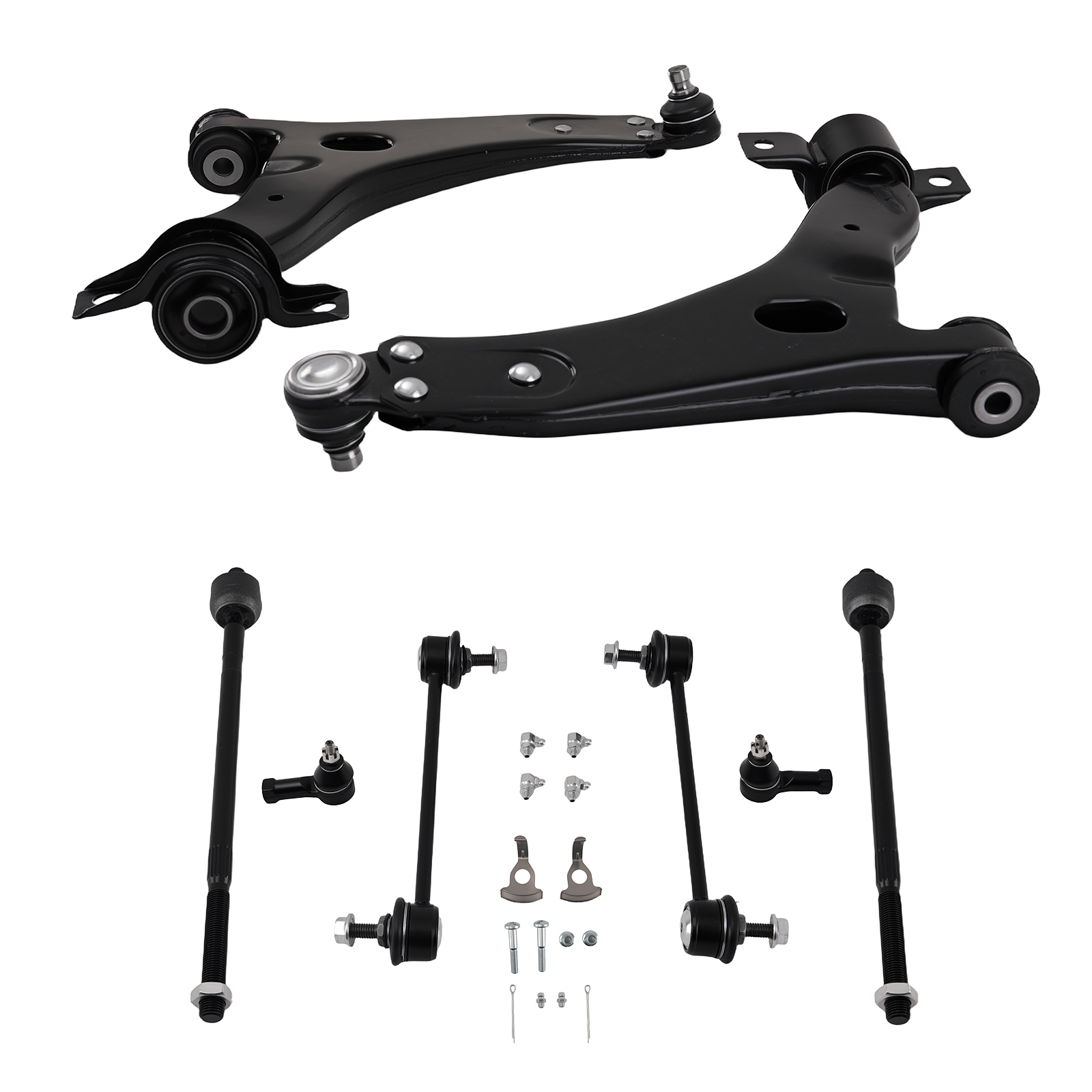

Photos from current listings. Actual item, color, and included accessories may vary.
Ford Focus Control Arm Buying Guide
A Ford Focus control arm is the pivoting link between the chassis and wheel hub that carries cornering loads and sets camber and caster; the primary trade-off is stamped-steel with rubber bushings versus cast-aluminum or reinforced stamped arms with uprated bushings and ball joints. Durable options use sealed-for-life ball joints and bonded or polyurethane bushings matched to the Focus generation, while compromises reuse worn ball-joint housings, omit alignment hardware, or bundle tie rods that do not match the submodel.


At a glance
- Category
- Suspension, Steering & Brake Parts
- Data updated
- Nov 15, 2026
Current offers
Highlights
- Focus control arms differ by generation (Mk1 2000-2004, Mk2 2005-2011, Mk3 2012-2018) with distinct arm geometry, ball-joint taper, and bushing diameters — arms are not interchangeable across generations.
- OE-style arms use stamped steel with rubber bushings and a non-serviceable ball joint; performance arms use cast aluminum or boxed steel with polyurethane bushings for reduced deflection.
- Ball-joint stud diameter and taper angle must match the steering knuckle; a mismatched taper causes premature wear and loose steering even if the arm bolts to the subframe.
- Complete arm kits include new mounting bolts and nuts; reusing torque-to-yield subframe bolts risks fastener failure and changes alignment under load.
Best use cases
- Best fit: daily-driven Mk2 Focus (2005-2011) with worn bushings — choose OE-style stamped arms with sealed ball joints and new mounting hardware for stock ride and alignment.
- Best fit: Mk3 Focus driven aggressively or on rough roads — choose cast-aluminum or reinforced arms with polyurethane bushings for sharper steering response and longer bushing life.
- Wrong fit: buying a multi-piece kit that bundles tie rods and arms without confirming submodel (ST, RS, SVT) — knuckle and steering-rack differences make those parts incompatible.
- Skip: economy arms with unsealed ball joints and no grease fittings for any car seeing winter road salt — they fail within a few seasons.
Buying tips
- Decode the Focus generation from the VIN or door-jamb sticker before ordering; Mk1, Mk2, and Mk3 arms have different ball-joint tapers and bushing widths.
- Prefer arms with sealed-for-life ball joints and bonded rubber bushings for stock comfort; choose polyurethane bushings only if you accept more road noise and steering feel.
- Match ball-joint stud diameter to the knuckle — measure the old stud or cross-reference the OE part number rather than trusting 'universal' fitment charts.
- Buy complete left-and-right pairs with new pinch bolts and nuts; mixing a new arm with a worn opposite side preloads the sway bar and skews alignment.
Specs
| Arm Material | Stamped steel vs cast aluminum |
|---|---|
| Bushing Type | Rubber bonded vs polyurethane |
| Ball Joint | Sealed non-serviceable vs greasable |
| Fitment | Mk1/Mk2/Mk3 generation-specific |
Related searches
What to check before buying
- Confirm Focus generation and submodel (base, ST, RS, SVT) from VIN — arm geometry and ball-joint taper differ between them.
- Measure the old ball-joint stud diameter and taper, and compare to the new arm's specification before installation.
- Verify the kit includes new subframe mounting bolts and ball-joint pinch bolts, since these are torque-to-yield and not reusable.
- Check that the new bushings match the subframe bracket diameter — oversized or undersized bushings cause clunks and misalignment.
FAQ
Data sources: eBay / Amazon listings and product attribute feeds Data updated Nov 15, 2026.
Some links on this page are affiliate links. If you buy after clicking one, we may earn a commission at no extra cost to you. This does not change which products appear here or their order. Affiliate disclosure.