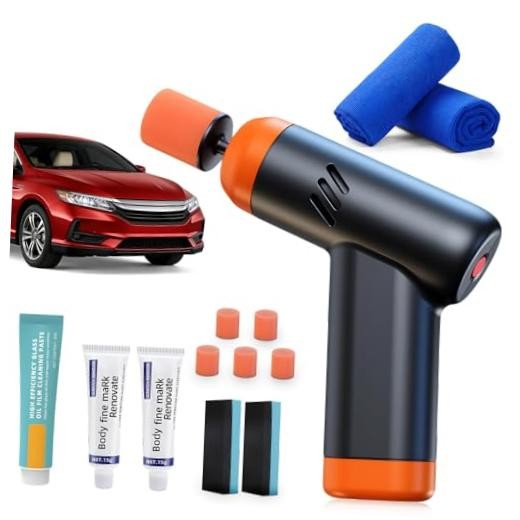

Photos from current listings. Actual item, color, and included accessories may vary.
Cordless Car Polisher Buying Guide
Cordless car polishers are battery-powered rotary or dual-action machines built for paint correction away from wall outlets, where runtime, pad torque, and battery platform compatibility define real capability. The core trade-off is between lightweight 12V mini polishers for spot correction and full-size 18V/20V dual-action units that sustain pad rotation under load. Buy a platform with a brushless motor and standardized battery family if you need repeatable correction; skip generic single-battery kits that cannot maintain OPM under pressure.


At a glance
- Category
- Car Polishers & Compounds
- Data updated
- Nov 15, 2026
Current offers
Highlights
- Motor type decides durability: brushless DC motors run cooler and hold OPM under load, while brushed motors in budget mini polishers overheat during extended panel work.
- Orbit diameter separates tiers: 8mm dual-action throws finish safely, 15mm–21mm throws correct faster but demand more technique and larger backing plates.
- Battery platform compatibility is the real cost driver—18V/20V packs shared with drills and impact drivers beat proprietary one-off batteries.
- Rotary vs dual-action: rotary polishers cut faster but risk holograms and burn-through; dual-action is the safe default for hobbyists and mobile detailers.
Best use cases
- Pick a 12V mini polisher with 1-inch to 3-inch pads for headlight restoration, scratch spot repair, and tight bumper areas—skip full-size DA units for these tasks.
- Choose an 18V/20V dual-action polisher with 5-inch to 6-inch backing plate for full-panel paint correction and polishing; a 12V mini will stall on large flat panels.
- For mobile detailing without power access, buy a two-battery kit on a shared tool platform and skip single-battery bundles that die mid-panel.
- Avoid cordless rotary polishers unless you already have wool pad and hologram-removal experience; dual-action is the correct first cordless machine for paint safety.
Buying tips
- Match backing plate to pad size: a 5-inch backing plate runs 5.5-inch to 6-inch pads; undersized plates cause pad failure and uneven correction.
- Require at least 2.0Ah to 4.0Ah battery packs for panel work—compact 1.5Ah packs cut runtime to minutes under load and sag voltage.
- Confirm the battery family: 18V/20V packs from a major cordless tool platform give replacement and expansion options; sealed proprietary batteries become e-waste.
- Check OPM and orbit specs: dual-action machines in the 4,000–6,800 OPM range with 8mm–15mm throw balance correction speed against paint safety.
Specs
| Motor Type | Brushless DC vs brushed |
|---|---|
| Power Class | 12V mini vs 18V/20V full-size |
| Action Type | Dual-action vs rotary |
| Pad/Plate Size | 1–3 in spot vs 5–6 in panel |
Related searches
What to check before buying
- Measure your pad inventory and backing plate diameter—cordless polishers ship with 1-inch, 3-inch, 5-inch, or 6-inch plates and pads are not interchangeable.
- Verify your battery platform: if you already own 18V/20V packs from a tool brand, buy the bare tool or kit in that family.
- Confirm charger voltage and plug standard for your region; cordless kits ship with region-specific chargers.
- Plan for a backing plate and pad kit separately—most bare tools include one plate, and correction requires multiple pad grades.
FAQ
Data sources: eBay / Amazon listings and product attribute feeds Data updated Nov 15, 2026.
Some links on this page are affiliate links. If you buy after clicking one, we may earn a commission at no extra cost to you. This does not change which products appear here or their order. Affiliate disclosure.