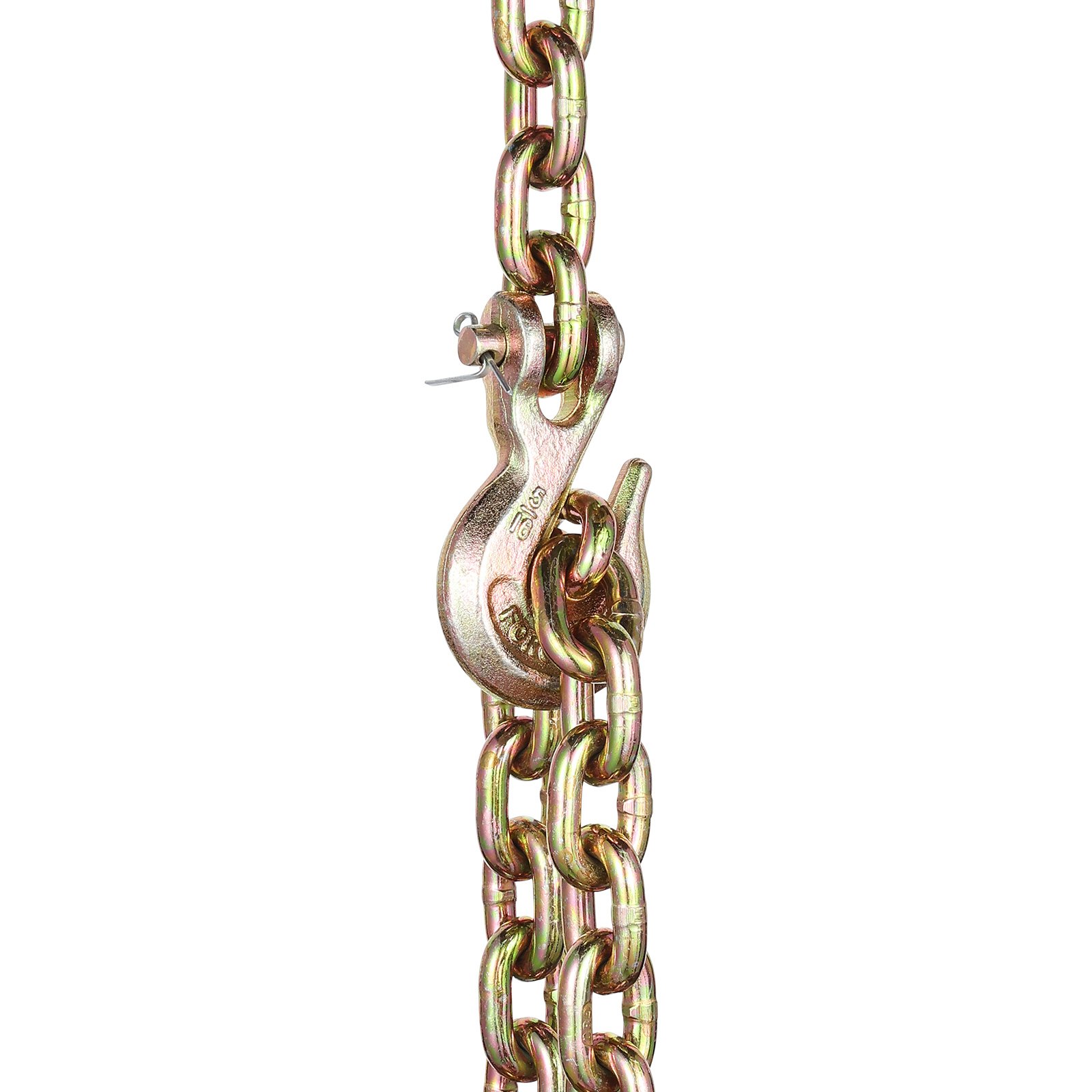

Photos from current listings. Actual item, color, and included accessories may vary.
Heavy Duty Towing Buying Guide
Heavy-duty towing covers load-securing and recovery gear rated for high working loads, where the core trade-off is between G70/G80/G100 chain grades, hook type, and certified working load limits versus non-certified hardware. The decision rule: match the chain grade and safe working load to your transported load with a 3:1 design factor, and reject any binder or tow strap without a stamped grade and WLL.


At a glance
- Category
- Towing, Roof Racks & Cargo
- Data updated
- Nov 15, 2026
Current offers
Highlights
- Chain grade determines strength: G70 is high-test, G80 is transport-grade alloy, G100 is higher-alloy for extreme loads; Grade 30 proof coil is not for overhead or transport binding.
- Binder chain WLL scales with diameter: 5/16-inch G80 is typically rated around 4,900 lb WLL, while 3/8-inch G80 steps up to roughly 7,100 lb WLL.
- Clevis grab hooks engage chain links and are preferred over slip hooks for binding because they won't slip off the link under load.
- Design factor for transport binding is typically 3:1 or 4:1, so the chain's breaking strength must be at least three times the load it secures.
Best use cases
- Best fit: securing heavy equipment, logs, or vehicles on a flatbed trailer — choose G80 5/16-inch or 3/8-inch binder chains with clevis grab hooks and matching binders.
- Best fit: logging and timber transport — use G80 or G100 chains with grab hooks and chain binders, plus edge protectors to prevent link abrasion.
- Wrong fit: overhead lifting or recovery winching — binder chains are for load restraint, not lifting; use slings or recovery straps rated for those tasks.
- Skip: Grade 30 or unmarked chain for highway transport — it lacks the WLL and certification for load binding and may fail inspection.
Buying tips
- Match chain diameter to load: 5/16-inch G80 (~4,900 lb WLL) for mid-size loads, 3/8-inch G80 (~7,100 lb WLL) for heavier equipment and vehicles.
- Confirm the chain is stamped G80 or G100 along with the WLL; unmarked chain is not acceptable for commerce or DOT-regulated transport.
- Use clevis grab hooks sized to the chain link; a hook that is too wide can slip off the link, and one too narrow won't seat properly.
- Pair binder chains with lever-style or ratchet load binders of matching grade, and use edge protectors at sharp contact points to avoid link damage.
Specs
| Chain Grade | G70 / G80 / G100 transport grade |
|---|---|
| Typical WLL | 4,900–7,100 lb (5/16–3/8 in G80) |
| Hook Type | Clevis grab vs slip hook |
| Design Factor | 3:1 or 4:1 for load binding |
Related searches
What to check before buying
- Verify the trailer or truck bed anchor points are rated for the chain's WLL and are free of corrosion or deformation.
- Measure your load's weight and the anchor point spacing so chain length (e.g., 14.2 ft) reaches with enough links for the binder.
- Check that the chain grade and WLL stamping matches your state/DOT tie-down requirements for the load class you are hauling.
- Confirm hook throat opening fits your trailer D-rings or stake pockets; add edge protectors for sharp loads.
FAQ
Data sources: eBay / Amazon listings and product attribute feeds Data updated Nov 15, 2026.
Some links on this page are affiliate links. If you buy after clicking one, we may earn a commission at no extra cost to you. This does not change which products appear here or their order. Affiliate disclosure.