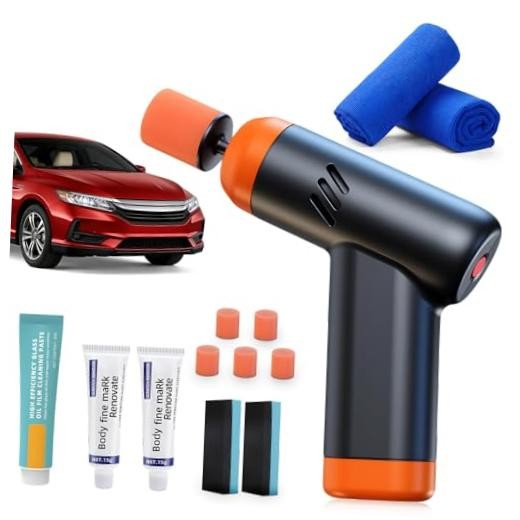

Photos from current listings. Actual item, color, and included accessories may vary.
Mini Car Polisher Buying Guide
A mini car polisher is a compact, often cordless rotary or dual-action tool sized for spot correction, tight panels, and trim work where a full-size 6-inch polisher cannot reach. The core trade-off is between true paint-safe orbital motion and cheap direct-drive spinners that risk holograms and burn-through on edges. Choose a tool with defined orbit stroke and variable speed control; skip fixed-speed direct-drive units sold as detailing kits.


At a glance
- Category
- Car Polishers & Compounds
- Data updated
- Nov 16, 2026
Current offers
Highlights
- Dual-action (DA) mini polishers use a free-floating backing plate with 8–12 mm orbit stroke, which safely distributes heat and avoids rotary swirl marks on factory clear coat.
- Rotary mini polishers spin the pad on a fixed axis at 2,000–5,000 OPM and correct faster but require pad control and lower speeds on plastic trim and panel edges.
- Cordless mini polishers run 12 V or 16 V lithium-ion packs; runtime is typically 20–40 minutes per charge at mid-speed, so a spare battery or corded backup matters for full-panel work.
- Backing plate size drives reach: 1-inch and 2-inch plates fit emblems, door jambs, and headlights; 3-inch plates cover mirror caps and bumper corners without masking large areas.
Best use cases
- Best fit: spot correction on door edges, fuel doors, and mirror caps — pick a 2-inch or 3-inch DA with variable speed and a soft backing plate to avoid burning thin clear coat.
- Best fit: headlight restoration and plastic trim polishing — choose a cordless rotary or DA with low minimum speed (under 2,000 OPM) and 1-inch pads for controlled material removal.
- Wrong fit: full-hood or roof compounding — a mini polisher's small orbit and limited battery runtime leave large panels uneven; step up to a corded 5-inch or 6-inch DA.
- Wrong fit: heavy oxidation removal on neglected paint — mini tools lack the torque and heat dissipation; use a full-size rotary or DA first, then refine with the mini.
Buying tips
- Match backing plate to pad diameter exactly: a 3-inch plate takes 3-inch pads; forcing a 4-inch pad on a 3-inch plate causes pad curl and uneven contact.
- Prioritize variable speed with a low starting point near 2,000 OPM; fixed-speed mini polishers at 5,000+ OPM are too aggressive for factory clear coat on edges.
- For cordless kits, confirm the battery voltage and cell type (12 V vs 16 V Li-ion) and that the charger is included; bare-tool listings require a compatible battery platform.
- Check thread size on the spindle: 5/16-24 is the common mini-polisher standard, while some 1-inch tools use M8 or proprietary quick-change; pads and plates must match.
Specs
| Action Type | Dual-action orbital vs rotary |
|---|---|
| Orbit Stroke | 8–12 mm (DA) / 0 mm (rotary) |
| Backing Plate | 1 in / 2 in / 3 in |
| Power Source | 12–16 V Li-ion cordless / corded |
Related searches
What to check before buying
- Measure the tightest area you need to polish — if it is narrower than 3 inches, confirm the tool accepts a 1-inch or 2-inch backing plate.
- Confirm your power source: cordless units need a charged Li-ion pack and a spare for multi-panel work; corded mini polishers need a nearby outlet and a compatible plug standard.
- Verify pad compatibility before buying: the kit's pad diameter must equal the backing plate diameter, and the spindle thread must match replacement pads you plan to use.
- Check clearance around emblems and trim: a mini polisher head plus pad needs roughly 1 inch of surrounding space to spin without striking adjacent panels.
FAQ
Data sources: eBay / Amazon listings and product attribute feeds Data updated Nov 16, 2026.
Some links on this page are affiliate links. If you buy after clicking one, we may earn a commission at no extra cost to you. This does not change which products appear here or their order. Affiliate disclosure.