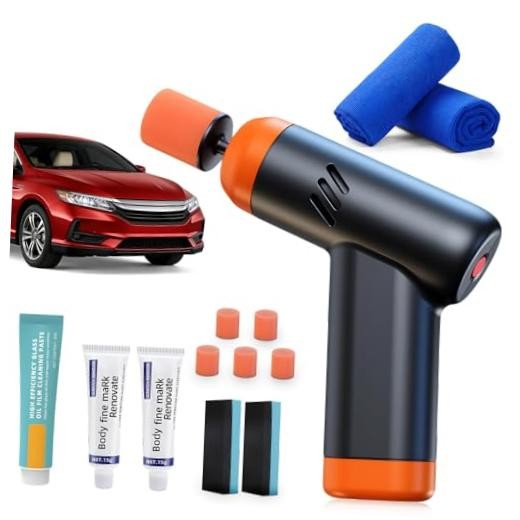

Photos from current listings. Actual item, color, and included accessories may vary.
Cordless Polisher Car Buying Guide
A cordless car polisher is a battery-powered orbital or rotary tool that removes swirl marks, applies wax, and corrects paint without a wall cord. The core trade-off is battery voltage and orbit throw versus weight and run time: 12V mini polishers are light and safe for tight areas but lack correction power, while 18V/20V full-size dual-action units deliver real paint correction at the cost of bulk. The decision rule is simple: buy a 12V mini only for wax application and spot polishing; buy an 18V/20V dual-action polisher with at least a 15mm orbit for genuine swirl removal and paint correction.


At a glance
- Category
- Car Polishers & Compounds
- Data updated
- Nov 16, 2026
Current offers
Highlights
- Voltage tiers define capability: 12V mini polishers spin 2–3 inch pads for spot work and wax, while 18V/20V units drive 5–6 inch pads with enough torque for compounding.
- Dual-action (DA) random orbital polishers are safer for beginners because the spinning and oscillating motion prevents holograms and burn-through that a rotary can cause.
- Orbit throw (8mm vs 15mm vs 21mm) determines correction speed: larger throws cover more area per pass but require more pad pressure control on curved panels.
- Battery platform compatibility matters: buying into an existing 18V/20V tool ecosystem (e.g., Makita LXT, Milwaukee M18, DeWalt 20V MAX) avoids orphaned batteries and chargers.
Best use cases
- Best fit: 12V mini cordless polisher with 2–3 inch pads for headlight restoration, door jambs, bumper scuffs, and wax application in tight areas — skip it for full-panel swirl removal.
- Best fit: 18V/20V dual-action polisher with 5–6 inch backing plate and 15mm+ orbit for one-step polish and compound on full hoods, roofs, and doors — skip underpowered 12V units for this job.
- Best fit: Rotary cordless polisher only for experienced users doing heavy defect removal or gelcoat — skip rotary if you are new to machine polishing and want burn-through protection.
- Wrong fit: Buying a cordless polisher for heavy oxidation removal on a whole vehicle — corded 8mm DA with consistent power or a rotary is faster and cheaper than cycling multiple battery packs.
Buying tips
- Match pad size to battery: 12V polishers run 2–3 inch pads (50–75mm), 18V/20V run 5–6 inch (125–150mm); larger pads demand more torque and drain smaller batteries faster.
- Choose a dual-action polisher with a 15mm orbit as the sweet spot for car paint — 8mm is safe but slow, 21mm is fast but harder to control on tight curves.
- Check battery capacity in Ah, not just voltage: a 2.0Ah 18V pack gives roughly 20–30 minutes of polishing, so plan on 4.0Ah+ packs or spares for a full car.
- Verify backing plate thread and pad attachment (hook-and-loop) before buying consumables — 5/16-24 and M14 threads are common but not universal across brands.
Specs
| Power Source | 12V mini vs 18V/20V full-size |
|---|---|
| Motion Type | Dual-action orbital vs rotary |
| Orbit Throw | 8mm / 15mm / 21mm |
| Pad Size | 2–3 in mini / 5–6 in full |
Related searches
What to check before buying
- Measure your working area: a 12V mini with 3-inch pads fits door handles and pillars; a 5-inch DA needs at least 6 inches of clearance around the panel.
- Confirm you own or plan to buy into a battery platform — orphaned 18V batteries and chargers add significant cost and e-waste.
- Check charger voltage and plug standard for your region (120V US vs 230V EU) — many cordless kits ship with region-specific chargers.
- Budget for consumables: pads, compounds, and microfiber towels are not included in most bare-tool listings and are required for safe polishing.
FAQ
Data sources: eBay / Amazon listings and product attribute feeds Data updated Nov 16, 2026.
Some links on this page are affiliate links. If you buy after clicking one, we may earn a commission at no extra cost to you. This does not change which products appear here or their order. Affiliate disclosure.