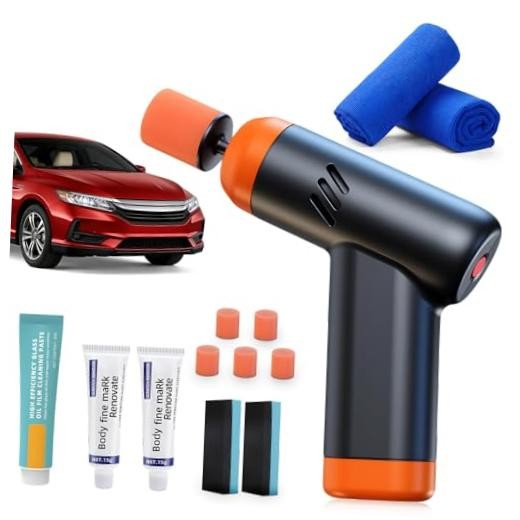

Photos from current listings. Actual item, color, and included accessories may vary.
Cordless Polisher Buffer Buying Guide
A cordless polisher buffer is a battery-powered dual-action or rotary tool that removes swirl marks and applies wax without a wall outlet. The core trade-off is torque and run time versus portability: compact 12V mini buffers trade correction power for reach, while 18V/20V full-size units need high-capacity packs to sustain pad rotation under load. The decision rule: buy a unit whose battery platform and throw match your panel size and defect severity, and skip any kit that hides battery voltage or pad diameter behind vague '13-piece' bundle language.


At a glance
- Category
- Car Polishers & Compounds
- Data updated
- Nov 16, 2026
Current offers
Highlights
- Dual-action (DA) polishers with 8mm throw suit finishing and waxing; 15mm+ long-throw DA units correct faster but stall on curved panels without forced rotation.
- Voltage class dictates torque: 12V mini buffers spin 2-3 inch pads for spot work, while 18V/20V units drive 5-6 inch pads and need 4.0Ah+ packs to avoid voltage sag.
- Battery platform lock-in matters more than the tool: choose a brand whose 18V/20V packs you already own, since bare-tool vs kit pricing and future tool compatibility hinge on it.
- Pad size must match backing plate: 5-inch pads need a 5-inch hook-and-loop plate, and mismatched velcro diameter causes pad walk and uneven heat buildup.
Best use cases
- Best fit: a 12V mini buffer with 2-3 inch pads for motorcycle tanks, pillars, headlights, and tight bumper areas where a full-size DA cannot reach.
- Best fit: an 18V/20V DA with 5-inch pads and two 4.0Ah+ batteries for full-car paint correction and waxing on sedans and SUVs.
- Wrong fit: buying a high-voltage rotary buffer as a first polisher—rotary tools burn edges fast and demand wool-pad and RPM discipline most beginners lack.
- Wrong fit: a single-battery kit with a 2.0Ah compact pack for full-panel correction—run time drops under 20 minutes at load and the pack overheats.
Buying tips
- Match pad diameter to panel: 2-3 inch for spot/trim work, 5-6 inch for hoods, roofs, and doors; a 5-inch pad on a 3-inch plate is unsafe and ineffective.
- Pick 18V/20V over 12V if you plan full-car correction—12V mini buffers lack the torque to spin a 5-inch pad under pressure and will stall.
- Demand at least 4.0Ah per battery for DA correction; 2.0Ah packs deliver roughly half the run time and heat up faster under sustained load.
- Confirm the battery platform (e.g., Makita LXT 18V, Milwaukee M18, DeWalt 20V MAX) before buying a bare tool—cross-platform adapters add resistance and void thermal safety.
Specs
| Motor/Drive Type | Dual-action orbital vs rotary |
|---|---|
| Voltage Class | 12V mini vs 18V/20V full-size |
| Pad Diameter | 2-3 in spot / 5-6 in panel |
| Battery Capacity | 2.0Ah compact vs 4.0Ah+ HD |
Related searches
What to check before buying
- Measure your largest panel and tightest gap: if you need to reach under 3 inches, a mini buffer is mandatory alongside any full-size unit.
- Confirm your existing battery platform voltage and connector—bare tools only make sense if you already own compatible 18V/20V packs.
- Check pad and backing-plate diameter match (5-inch pad/5-inch plate) and that replacement pads are standard hook-and-loop, not proprietary.
- Verify charger plug type and voltage for your region (120V US vs 230V EU) and that the kit includes the correct charger, not just a USB cable.
FAQ
Data sources: eBay / Amazon listings and product attribute feeds Data updated Nov 16, 2026.
Some links on this page are affiliate links. If you buy after clicking one, we may earn a commission at no extra cost to you. This does not change which products appear here or their order. Affiliate disclosure.