Choosing between dash cams is really a choice about coverage: do you want the widest possible view around the vehicle, or do you want a lower listed price with the core front, rear, and cabin angles covered? The two models here both focus on multi-camera recording, black housings, and G-sensor-style event capture, but they are not aimed at the exact same shopper.
Quick take
- Best for maximum angle coverage: 4-Channel Dashcam 360° 1080P HD Car Dash Cam Front Rear Inside Left Right. Its main appeal is right in the title: front, rear, inside, left, and right coverage through a 4-channel setup.
- Best for spending less while keeping multi-view recording: Dash Cam Car HD 1080P Front/Rear/Inside Dual Lens Video Recorder Camera G-Sensor. It focuses on front, rear, and interior recording with a lower listed cost.
- Main decision point: choose the 4-channel DXcam if side views matter to you; choose the Hanks Minerals model if the front/rear/inside arrangement is enough for your driving setup.
Listed price comparison
| Dash cam | Listed price | Price bar |
|---|---|---|
| 4-Channel Dashcam 360° 1080P HD Car Dash Cam Front Rear Inside Left Right | USD 39.98 | |
| Dash Cam Car HD 1080P Front/Rear/Inside Dual Lens Video Recorder Camera G-Sensor | USD 22.98 |
The spread is meaningful: the lower listed price is 43% below the higher one. That difference makes the choice less about tiny spec changes and more about whether the added side-facing coverage is worth moving to the higher end of this small comparison.
Decision matrix
Choose the 4-channel 360° model if:
- You want a setup described around front, rear, inside, left, and right views.
- You like having a larger stated display size, with a 3.16-inch screen mentioned in the description.
- You want support for a memory card capacity up to 128GB, with the card not included.
- You prefer a feature set that includes loop recording, motion detection, night vision, and G-Sensor.
Choose the front/rear/inside model if:
- Your priority is a lower entry cost while still covering more than just the windshield view.
- You specifically want a front camera, cabin camera, and rear camera arrangement.
- A 2.0-inch IPS screen is enough for checking the live view.
- You are fine with memory card support up to 64GB, with the card not included.
Think twice about the 4-channel model if:
- You do not care about left and right side views.
- You want the smallest spend in this pair.
Think twice about the Hanks Minerals model if:
- You want side-window recording called out as part of the system.
- You prefer the higher stated memory card ceiling between these two choices.
Concise product notes
4-Channel Dashcam 360° 1080P HD Car Dash Cam Front Rear Inside Left Right
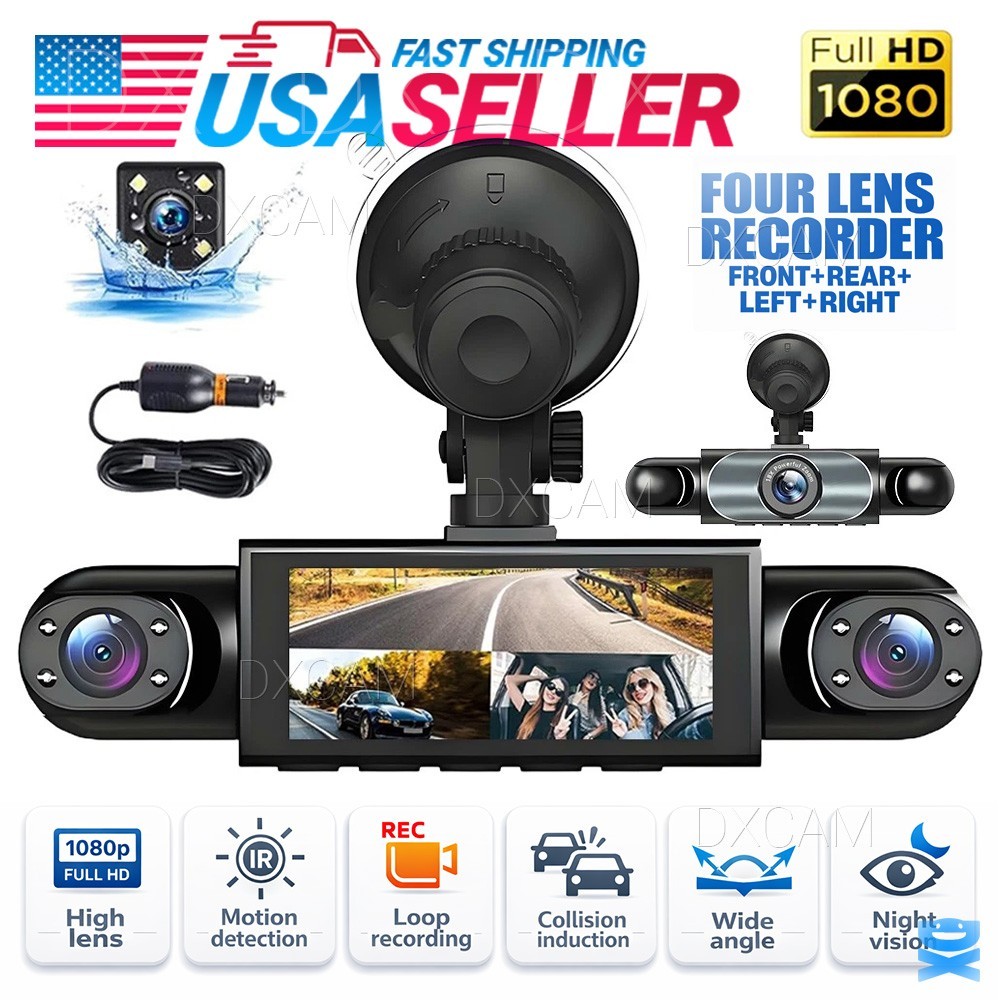
This DXcam model is the stronger fit for shoppers who want the broadest stated camera layout. The description centers on a front camera, rear camera, and two rotatable cameras for cabin or side-window recording, so it is better aligned with drivers who want more than the usual forward-and-rear view. It also calls out HDR, WDR, infrared lights, and operation across a wide temperature range. The tradeoff is cost within this comparison, and the memory card is not included. It may also be more than you need if your main goal is simply front, rear, and cabin recording rather than side coverage.
Dash Cam Car HD 1080P Front/Rear/Inside Dual Lens Video Recorder Camera G-Sensor
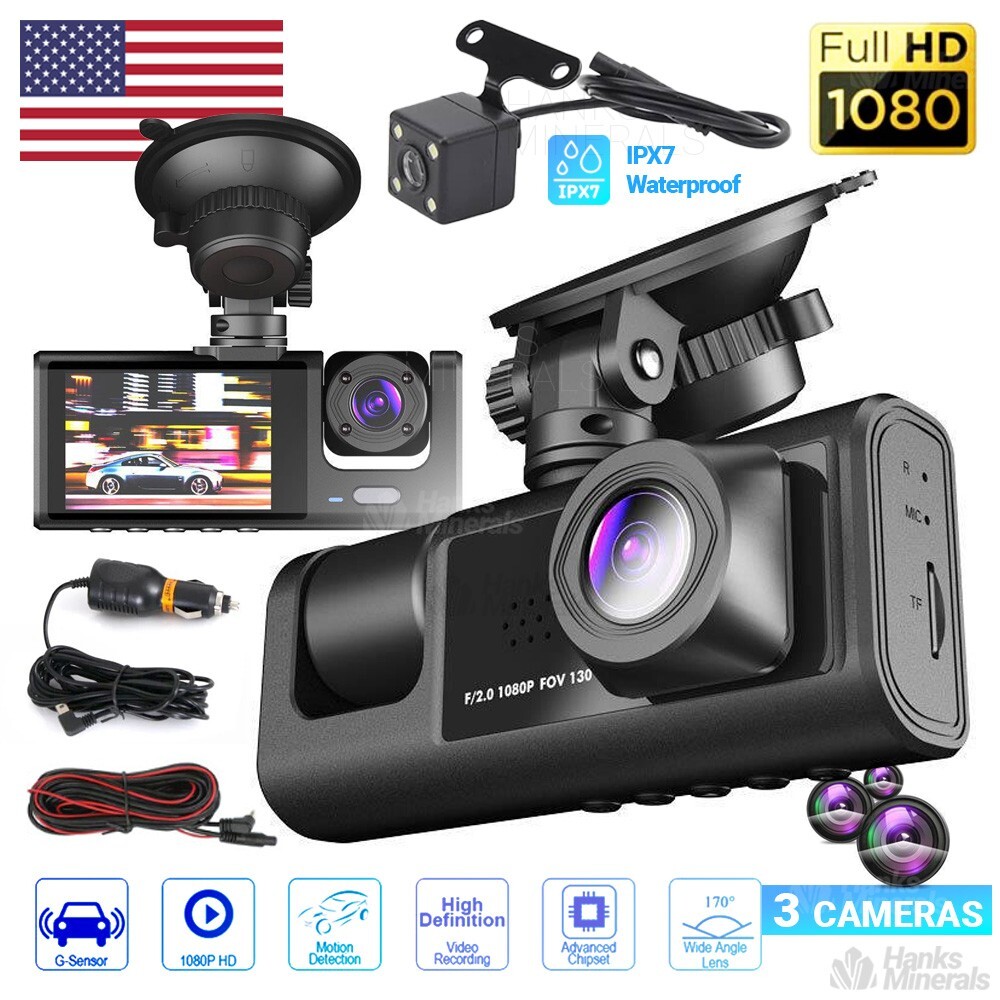
The Hanks Minerals dash cam is the more economical choice for shoppers who still want multiple recording angles. Its description lists a 170° front camera, 120° cabin camera, and 110° rear camera, which gives it a practical front/rear/interior focus. The G Sensor, loop recording, IPS screen, USB 2.0 interface, and 320mAH battery capacity round out a straightforward feature set. The limitation is that the cabin and rear cameras are described at 720P, while the front camera is 1080P. Memory card support also tops out at 64GB, and the Micro SD/TF card is not included.
How to choose based on driving use
For a commuter who mainly wants a record of the road ahead and behind, the Hanks Minerals model has the simpler match. It still includes interior recording, which can matter for rideshare-style cabin awareness or for drivers who want a view inside the vehicle. Its smaller screen and lower memory card ceiling are reasonable tradeoffs if the priority is keeping the setup modest.
For a driver who worries about side impacts, parking-lot interactions, or situations where side-window footage may matter, the 4-channel DXcam has the clearer advantage. The left and right coverage language separates it from the front/rear/inside model. That does not automatically make it the better buy for everyone, but it does make it the more complete choice for shoppers who want a surround-style arrangement.
Display preference may also matter. A larger screen can be easier to glance at when adjusting camera views, while a smaller screen keeps the unit more compact-looking. The 4-channel model mentions a 3.16-inch display, while the Hanks Minerals model lists a 2.0-inch IPS 4:3 display. If you only use the screen for setup and occasional checks, either format may be sufficient; if live viewing is more important to you, the larger display is worth weighing.
Storage expectations are another separator. Both models note that a memory card is not included, but their stated support differs. The DXcam supports up to 128GB, while the Hanks Minerals model supports up to 64GB Micro SD/TF. If you tend to record longer drives before moving files or overwriting older footage, the higher ceiling may be useful.
Final recommendation
Pick the 4-Channel Dashcam 360° 1080P HD Car Dash Cam Front Rear Inside Left Right at USD 39.98 if your main reason for buying is wider vehicle coverage, especially the front, rear, inside, left, and right arrangement. The 43% price gap is easiest to justify when side views are part of what you want.
Pick the Dash Cam Car HD 1080P Front/Rear/Inside Dual Lens Video Recorder Camera G-Sensor at USD 22.98 if you want a lower-cost dash cam with front, rear, and cabin recording. It gives up the broader side-view emphasis and the higher stated memory card ceiling, but it is the clearer choice when the core three-angle setup is enough.